Fire-Resistant Landscaping and Home Inspection Considerations in Southern California
Reading time: 14 minutes
If you own a home in Southern California, you already know the drill: every year, the sky turns orange, evacuation alerts buzz on your phone, and the question hangs in the air — is my home truly prepared? After the catastrophic fires that swept through Los Angeles County in early 2025, claiming thousands of structures and reshaping entire neighborhoods, the conversation about fire-resistant landscaping and home inspection has never felt more urgent — or more personal.
Here’s the straight talk: Most SoCal homeowners underestimate how much their landscaping decisions directly influence their home’s survivability in a wildfire. Your yard isn’t just curb appeal — it’s either a fuel ladder feeding flames straight to your roofline or a strategic buffer that buys critical time. And your home inspection? It’s your fire-readiness report card.
This guide walks you through everything from choosing the right plants to knowing exactly what inspectors are looking for in 2026 — so you can turn potential vulnerability into genuine resilience.
Table of Contents
- Why Fire-Resistant Landscaping Matters More Than Ever in 2026
- Understanding Defensible Space: The Zone System Explained
- Best Fire-Resistant Plants for Southern California
- Landscape Design Strategies That Reduce Fire Risk
- Home Inspection Checklist: What Inspectors Look For
- Comparing Fire-Risk Factors: A Homeowner’s Reference Table
- Common Challenges and How to Overcome Them
- Frequently Asked Questions
- Your Fire-Resilience Roadmap: Next Steps
Why Fire-Resistant Landscaping Matters More Than Ever in 2026
Southern California’s wildfire season has fundamentally changed. What was once a seasonal concern from October through December has evolved into a year-round threat. The California Department of Forestry and Fire Protection (CAL FIRE) reported that by mid-2026, over 1.2 million acres had already burned statewide — a trajectory that climate scientists attribute to a combination of prolonged drought cycles, Santa Ana wind intensification, and urban-wildland interface expansion.
In the aftermath of the January 2025 Palisades and Eaton fires, which together destroyed more than 16,000 structures across Los Angeles County, city and county officials fast-tracked new landscaping compliance mandates. As of January 2026, Los Angeles County now requires homeowners in Wildland-Urban Interface (WUI) zones to complete a formal defensible space clearance inspection before renewing their home insurance — a shift that has sent tens of thousands of homeowners scrambling for guidance.
“The 2025 fires were a brutal lesson. We’ve known for decades that defensible space works — but compliance was always voluntary. Now it’s becoming a prerequisite for insurability.” — Dr. Alexandra Reyes, Fire Ecology Researcher, UCLA Institute of the Environment, 2026
The financial stakes are also staggering. According to the Insurance Information Institute, the average wildfire-related home insurance claim in California in 2025 exceeded $420,000 — and that’s for homes that were insured. An estimated 22% of SoCal homeowners in high-risk zones entered 2026 either uninsured or underinsured, largely because major carriers continued to exit the state market following unsustainable losses.
The good news? Thoughtfully implemented fire-resistant landscaping can reduce a home’s ignition risk by up to 40%, according to research published by the Insurance Institute for Business & Home Safety (IBHS) in late 2025. That’s not a small number — that’s the difference between a home that stands and one that becomes a statistic.
Understanding Defensible Space: The Zone System Explained
California law — specifically Public Resources Code Section 4291 — establishes a mandatory defensible space framework for homes in or near wildland areas. Think of it as a series of concentric rings around your home, each with different rules about what can grow, how it’s maintained, and what materials are permitted.
Zone 0: The Home Ignition Zone (0–5 Feet)
This is the most critical and most frequently neglected zone. Zone 0, sometimes called the “non-combustible zone,” encompasses everything within five feet of your home’s foundation and any attached structures like decks, fences, and garages. Research from the IBHS confirms that the majority of homes ignite not from direct flame contact but from ember accumulation — and Zone 0 is ground zero for that risk.
In Zone 0, the goal is simple: eliminate combustible materials entirely. That means replacing wood mulch with gravel or decomposed granite, removing dead vegetation from under decks, clearing pine needles from gutters and against walls, and ensuring any potted plants near the entrance are fire-resistant species in non-combustible containers. Many homeowners are surprised to learn that a simple bag of decorative bark mulch pressed against their foundation is enough to act as an ignition point during an ember shower.
Zone 1: The Lean, Clean, and Green Zone (0–30 Feet)
Zone 1 extends from your home’s edge to 30 feet outward (or to your property line, whichever comes first). The mandate here is to maintain “lean, clean, and green” landscaping — meaning plants should be well-irrigated, separated from each other to prevent fire spread, and free of dead or dry material.
Key rules in Zone 1 include: spacing between plants (shrubs should be 2–4 feet apart, trees should be 10 feet apart crown-to-crown), keeping grass mowed to 4 inches or less, removing dead branches up to 6 feet from the ground on trees, and eliminating all dead or dying plants. This zone is also where your choice of plant species has the greatest impact on fire behavior.
Zone 2: Reduced Fuel Zone (30–100 Feet)
Zone 2 extends from 30 to 100 feet from your home (or up to 200 feet on steep slopes). The goal here is to break up the continuity of vegetation so that fire cannot travel in an uninterrupted fuel path toward your structure. Horizontal spacing between plants increases, vertical “fuel ladders” — where ground cover connects to shrubs connects to tree canopies — must be eliminated, and native drought-tolerant species are strongly encouraged.
On slopes greater than 30%, these zones expand proportionally because fire spreads faster uphill. A home on a 45-degree canyon-facing slope in Altadena, for instance, effectively needs twice the clearance of a flat-lot home in Thousand Oaks to achieve equivalent protection.
Best Fire-Resistant Plants for Southern California
Here’s a critical distinction that often gets lost in translation: fire-resistant does not mean fireproof. Every organic material will eventually burn under extreme enough conditions. What fire-resistant plants do is slow ignition, reduce flame intensity, and minimize the amount of fuel available to a passing fire front — and in the context of a fast-moving wildfire, slowing things down by even a few minutes can mean everything.
Top Ground Covers and Low-Growing Plants
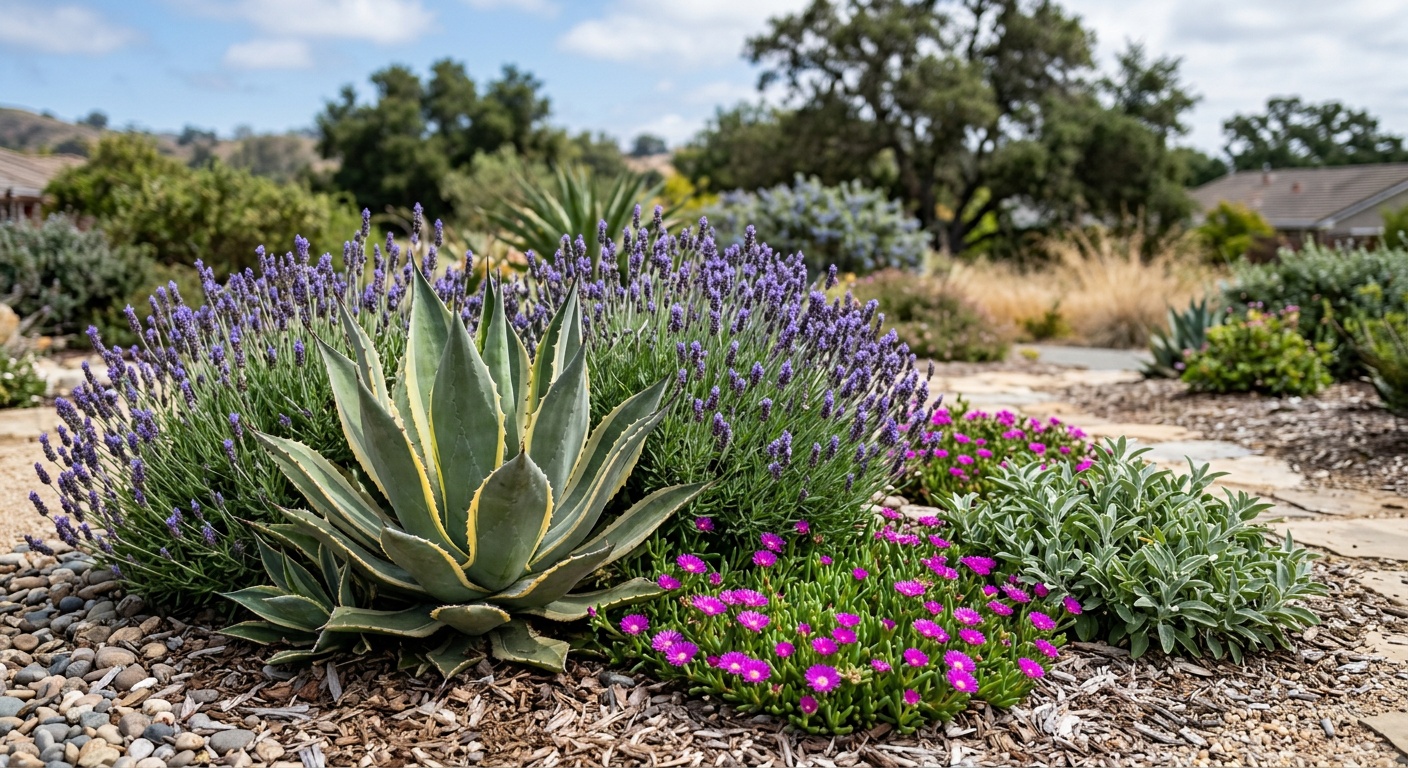
Dymondia margaretae (Silver Carpet) — This South African native is a landscaping staple in low-water SoCal gardens and an excellent choice for Zone 0 and Zone 1 ground coverage. It stays flat, retains moisture, and resists ignition remarkably well. It’s also deer-resistant, which matters significantly in foothill communities.
Ceanothus (California Lilac) — A beloved California native, Ceanothus varieties offer spectacular spring blooms, provide habitat for native pollinators, and have a relatively low resin content compared to chaparral species. Shorter varieties like Ceanothus gloriosus work well in Zone 1.
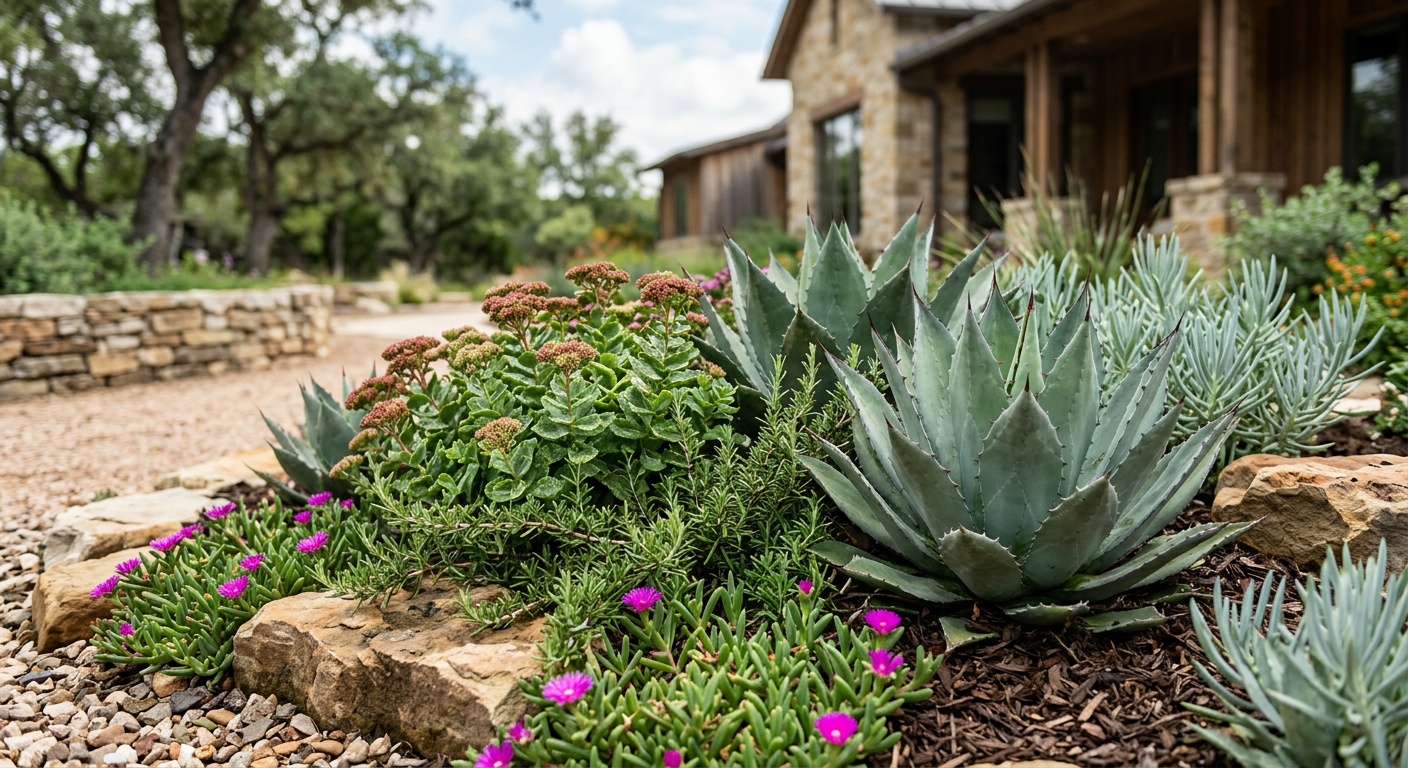
Agave and Aloe species — Their high moisture content makes them slow to ignite. They also require minimal water, making them ideal for water-restricted Southern California where drought conditions now persist for most of the year. Avoid clustering them, however — even succulents can burn once they dry out during a multi-day heat event.
Lantana camara — Colorful, low-growing, and drought-tolerant, Lantana is a popular fire-wise choice for Zone 1 borders. It spreads to fill gaps without becoming overly tall, minimizing vertical fuel accumulation.
Trees That Perform Better in Fire Conditions
Not all trees are created equal when it comes to fire behavior. Eucalyptus, for all its beauty and ubiquity in SoCal landscapes, is essentially a fire accelerant — its bark peels in long strips that become airborne firebrands, and its oil-rich leaves ignite explosively. If you have eucalyptus on your property within 100 feet of your home, a frank conversation with your fire-wise landscaper is overdue.
Better alternatives include Quercus agrifolia (Coast Live Oak), whose thick bark and high moisture content make it one of the most fire-resilient trees in the region. Cercis occidentalis (Western Redbud) is another excellent choice — smaller, manageable, and gorgeous in bloom. Pistacia chinensis (Chinese Pistache) offers reliable fire resistance with excellent drought tolerance once established.
Landscape Design Strategies That Reduce Fire Risk
Plant selection is only half the equation. How you arrange and maintain your landscape matters just as much — sometimes more. Consider the story of a Rancho Cucamonga homeowner whose neighbor’s home burned entirely in the 2024 Cucamonga fire while theirs survived. The difference wasn’t primarily the plants used but the strategic spacing, hardscape breaks, and maintenance schedule the surviving homeowner had implemented based on CAL FIRE’s “Home Ignition Zone” guidelines.
Use Hardscape as Fire Breaks
Patios, walkways, driveways, and retaining walls made from concrete, stone, or pavers serve double duty: they’re aesthetically functional and they interrupt the continuity of flammable material. In Zone 0 and near the inner edge of Zone 1, prioritizing gravel paths, stone borders, and concrete edging over wood-based alternatives significantly reduces ignition pathways.
Eliminate Fuel Ladders
A fuel ladder is what fire uses to climb from ground level up into tree canopies, and from there, to leap onto roof structures. Eliminating ladders means pruning tree branches so the lowest limb is at least 6–10 feet above ground, removing tall shrubs directly under trees, and keeping groundcover plants separated from mid-height plants separated from canopy trees. This vertical separation is as important as horizontal spacing.
Irrigation System Maintenance
A well-maintained drip irrigation system in Zone 1 keeps plants green and moisture-laden — a genuine fire deterrent during a heat event. However, systems must be checked for leaks and blockages seasonally. An irrigation system that fails during August heat means your Zone 1 plants become tinder by September. Smart irrigation controllers that respond to evapotranspiration rates are now widely available at Home Depot and Lowe’s for under $150 and are well worth the investment in a WUI zone.
The Driveway and Gate Factor
This one surprises many homeowners: your driveway’s width and your property gate’s opening mechanism directly affect fire department access — which matters for both suppression and your evacuation. CAL FIRE recommends driveways be at least 12 feet wide with 13.5 feet of vertical clearance to accommodate fire engines. If your gate doesn’t have a Knox Box (a secure key storage box for emergency access), many SoCal fire departments now require one for properties in Very High Fire Hazard Severity Zones.
Home Inspection Checklist: What Inspectors Look For
In 2026, home inspections in SoCal’s high-fire-risk zones have evolved considerably. Standard home inspectors are increasingly incorporating fire-readiness components into their assessments, and specialized wildfire home hardening inspections — separate from traditional home inspections — are now offered by CAL FIRE and many private inspection firms.
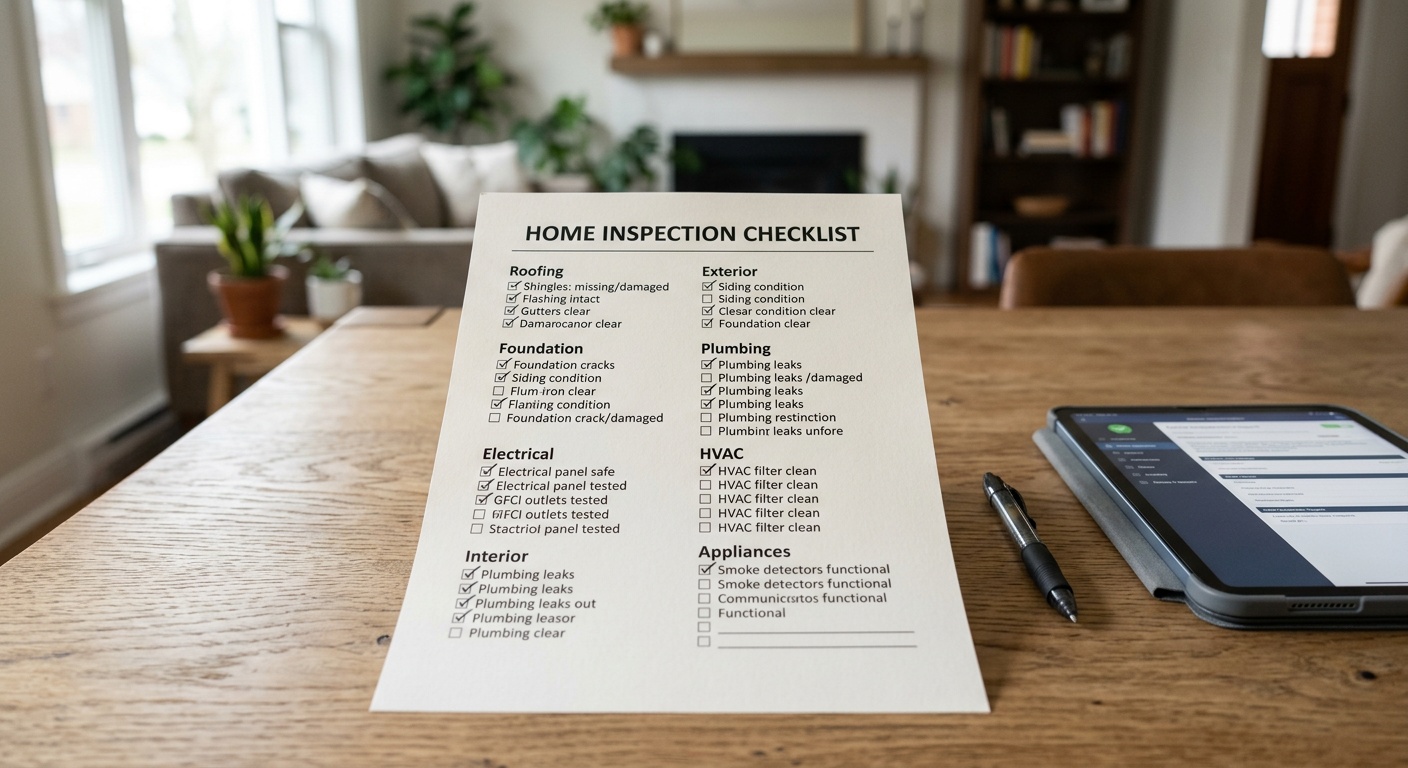
When a buyer, insurer, or lender orders a fire-risk home inspection in Southern California today, here’s what the checklist typically covers:
Roof and Gutters
The roof is the most ember-vulnerable part of any home. Inspectors will assess roofing material (Class A fire-rated materials like concrete or clay tile, metal roofing, or Class A asphalt shingles are required in most WUI zones), check for gaps at the ridge, eave, and hip connections where embers can infiltrate, and evaluate gutter condition. Gutters filled with pine needles, dried leaves, or debris are a primary ignition point. Gutter guards rated for ember resistance — specifically those with fine mesh screens — have become a standard recommendation in 2026 inspections.
Vents and Openings
Unscreened vents are among the most common — and most preventable — home fire vulnerabilities. Foundation vents, attic vents, soffit vents, and crawl space openings must all be fitted with 1/8-inch or finer metal mesh to prevent ember entry. Inspectors will physically examine each vent opening. Homes built before 2010 frequently fail this criterion, and retrofitting vent screens is one of the most cost-effective hardening measures available, typically running $200–$800 for a full home depending on the number of vents.
Exterior Walls and Deck Materials
Wood siding and wood decking are significant vulnerabilities in an ember environment. Inspectors will note the type of siding material (stucco, fiber cement, or fire-treated wood score better than untreated wood) and check for gaps, cracks, or deterioration where embers could accumulate. Decks present a particular challenge: a wood deck acts as a platform for ember accumulation and can ignite and burn inward to the home’s structure. Composite or PVC decking materials now carry fire ratings, and inspectors will flag unprotected wood decks as a high-priority remediation item.
Windows and Doors
Single-pane windows can shatter from radiant heat before any flame contact, allowing embers to enter. Dual-pane or tempered glass windows significantly improve heat resistance. Inspectors check window and door frames for combustible materials (vinyl frames score better than wood) and assess whether weather stripping is intact — gaps around doors are secondary ember entry points.
Attached Fences and Combustible Connections
A wood fence that connects to your home’s exterior wall is essentially a fire wick. Fire can travel along a fence and directly ignite your siding. Inspectors now routinely flag continuous wood fencing that connects to structures and recommend either replacing the final 5 feet with metal or masonry, or installing a gate break between the fence and the home’s wall.
Comparing Fire-Risk Factors: A Homeowner’s Reference Table
| Factor | High Risk | Lower Risk | Estimated Cost to Remediate |
|---|---|---|---|
| Roof Material | Wood shakes, unrated asphalt | Class A tile, metal, composite | $12,000–$35,000 |
| Vent Screens | Unscreened or >1/4-inch mesh | 1/8-inch metal mesh or ember-resistant | $200–$800 |
| Zone 0 Vegetation | Wood mulch, dry plants <5 ft from home | Gravel, decomposed granite, succulents | $500–$3,000 |
| Deck Material | Untreated wood decking | Composite, PVC, or concrete pavers | $8,000–$25,000 |
| Window Type | Single-pane, wood frames | Dual-pane tempered, vinyl or metal frame | $300–$1,200 per window |
Fire Risk Reduction: Impact by Improvement Area
The following chart reflects estimated percentage reduction in home ignition risk per improvement category, based on IBHS research data published in 2025:
~35%
~25%
~20%
~14%
~6%
Note: Percentages reflect relative contribution to overall ignition risk reduction when measures are implemented individually. Combined measures yield compounding benefits.
Common Challenges and How to Overcome Them
Challenge 1: HOA Restrictions vs. Fire Safety Requirements
This is one of the most frustrating friction points for SoCal homeowners in 2026. Homeowners’ associations in many planned communities still enforce aesthetic landscaping standards — lush green lawns, specific plant species, uniform fencing — that may directly conflict with fire-safety best practices. You may want to replace your front lawn with drought-tolerant gravel and native plants, and your HOA may fine you for doing so.
Here’s what changed: California Assembly Bill 2145, which took effect in January 2026, explicitly prohibits HOAs from restricting fire-resistant landscaping modifications mandated under CAL FIRE guidelines. If your HOA is blocking your compliance with state-required defensible space clearances, they are legally exposed. Document your communications, reference AB 2145 directly in writing, and if necessary, involve your county fire department — a letter from CAL FIRE to your HOA typically resolves the standoff quickly.
Challenge 2: Cost Barriers for Lower-Income Homeowners
Fire-hardening a home comprehensively can run from $15,000 to well over $80,000 depending on its current condition and the scope of work required. For many longtime SoCal residents — particularly seniors and lower-income families in communities like Sylmar, Chatsworth, or the Lake Arrowhead area — this is prohibitive. The result is a dangerous equity gap in wildfire preparedness.
The good news is that funding programs have expanded meaningfully in 2026. The California Governor’s Office of Emergency Services (Cal OES) administers the Wildfire Home Hardening Grant Program, which in 2026 offers up to $10,000 per qualifying low-to-moderate income household for approved hardening improvements. Additionally, the USDA’s Community Wildfire Defense Grant program (expanded under 2025 federal legislation) is now funding defensible space projects at the neighborhood level in many SoCal communities. Check with your local fire safe council — there are 11 active fire safe councils in Los Angeles County alone — for application guidance.
Challenge 3: Finding Qualified Contractors
The post-2025 fire rebuilding surge has created a contractor shortage throughout SoCal, and with demand for fire-hardening work at an all-time high, the market is unfortunately ripe for unqualified operators overpromising. In 2026, look specifically for landscapers who hold a California Certified Nurseryperson (CCN) credential with fire-wise specialization, or who are affiliated with the National Fire Protection Association’s Firewise USA program. For structural hardening work, verify that contractors are licensed with the California Contractors State License Board (CSLB) and carry both general liability and workers’ comp insurance. The CSLB’s online license check at cslb.ca.gov takes approximately two minutes and should be non-negotiable before signing any contract.
Frequently Asked Questions
Does fire-resistant landscaping actually reduce my homeowner’s insurance premium in California?
Yes — increasingly so in 2026. Following the 2025 fire losses, several carriers that re-entered the California market (or maintained coverage) began offering premium discounts of 5–20% for verified fire-hardening measures. State Farm, which resumed limited California underwriting in mid-2025, now requests a copy of your CAL FIRE defensible space clearance inspection when determining your premium tier. Documenting your improvements with dated photographs and retaining receipts from licensed contractors strengthens your case when negotiating coverage terms or appealing a non-renewal. The California FAIR Plan — the insurer of last resort for many SoCal homeowners — also announced in March 2026 that it will begin factoring home hardening scores into its pricing model by 2027.
How often do I need to have my defensible space inspected?
Under current California law, homes in State Responsibility Areas (SRAs) and Very High Fire Hazard Severity Zones (VHFHSZ) are subject to annual defensible space inspections by CAL FIRE or local fire departments. However, inspection resources are stretched thin, and proactive homeowners are advised to conduct a thorough self-assessment every spring (before fire season peaks) and after any significant wind or rain event that may have redistributed debris. Many SoCal fire departments offer free voluntary inspections — the Los Angeles County Fire Department’s Ready! Set! Go! program, for instance, will send a trained community outreach member to your property by appointment to walk through your defensible space and provide written recommendations at no cost.
What’s the difference between a standard home inspection and a wildfire home hardening inspection?
A standard home inspection — the kind ordered during a real estate transaction — covers structural integrity, plumbing, electrical, HVAC, and general habitability. It will note obvious fire-related deficiencies (like a wood-shake roof) but does not systematically evaluate wildfire preparedness. A wildfire home hardening inspection is a specialized assessment focused entirely on ember and flame vulnerability: vent screening, roofline integrity, Zone 0 conditions, attached structure materials, and defensible space compliance. In SoCal’s high-risk zones, buyers in 2026 are increasingly ordering both — the standard inspection and the wildfire-specific one — as separate reports. Some lenders operating in VHFHSZ areas are beginning to require the wildfire hardening inspection before funding. Cost for a dedicated wildfire inspection ranges from $250 to $600 depending on property size and inspector credentials.
Protecting What Matters: Your Fire-Resilience Action Roadmap
You’ve absorbed a lot of information. Now let’s turn it into momentum. The most important thing to know is this: you don’t have to do everything at once. Fire resilience is built incrementally, and every improvement you make — even small ones — meaningfully shifts the odds in your favor.
Here’s your practical five-step roadmap to implement starting today:
- Start with Zone 0 this weekend. Walk the perimeter of your home and remove all wood mulch, dead vegetation, and combustible debris within 5 feet of your foundation. Replace with gravel. This single action — achievable in a single Saturday — addresses one of the highest-probability ignition pathways for under $200 in materials.
- Schedule a free fire inspection within 30 days. Contact your local CAL FIRE unit or county fire department and request a voluntary defensible space inspection. Use their written feedback as your prioritized punch list. This costs you nothing and gives you an official, expert-generated improvement roadmap tailored to your specific property.
- Address vent screens within 90 days. Hire a licensed contractor to assess and replace any vents with 1/8-inch metal mesh or ember-resistant alternatives. This is your highest-ROI structural improvement in terms of cost versus risk reduction — typically under $800 for a full home.
- Develop a plant replacement plan by next spring. Work with a fire-wise landscape professional to identify which existing plants in Zone 1 are high-risk (particularly chaparral species with high resin content, eucalyptus, or overgrown drought-stressed shrubs) and create a phased replacement plan using the species outlined in this guide.
- Document everything and contact your insurer. Photograph your improvements, retain receipts, and proactively share your fire-hardening documentation with your insurance carrier. Even if your current insurer doesn’t yet offer a discount, you’re building a file that will be valuable when negotiating renewals or seeking new coverage in an increasingly restrictive market.
The broader trend is unmistakable: in Southern California, fire resilience is no longer optional infrastructure — it’s becoming a baseline requirement for homeownership, insurability, and community safety. The communities that adapt most thoughtfully to this reality will not only survive the next fire season but will emerge as models for sustainable living in a changing climate.
The question worth sitting with: What would it feel like to stand in your yard during the next evacuation warning and genuinely know you’ve done everything within your power to protect your home? That confidence is built one decision at a time — and the best time to start building it is right now.