Plumbing Red Flags in Homes Built Before 1980 in Southern California
Reading time: 14 minutes
You found your dream home in Pasadena. The vintage tile, the arched doorways, the mature avocado tree in the backyard — it’s everything you imagined. But behind those charming walls, a network of pipes, joints, and fixtures installed decades ago may be quietly working against you. In Southern California, where millions of homes were built before 1980, aging plumbing systems represent one of the most financially significant — and most overlooked — risks in residential real estate.
Here’s the straight talk: a beautiful exterior does not tell you anything about what’s happening beneath the slab. And in a region where a single slab leak repair can cost between $3,000 and $10,000, understanding your home’s plumbing heritage isn’t just smart — it’s essential.
Whether you’re buying a 1955 bungalow in Long Beach, renovating a 1967 split-level in the San Fernando Valley, or maintaining a charming Craftsman in San Diego’s North Park neighborhood, this guide arms you with the knowledge to spot the red flags before they become catastrophic failures.
Table of Contents
- Why Pre-1980 Homes in Southern California Deserve Special Scrutiny
- The Pipe Material Problem: What’s Hiding in Your Walls
- The Critical Red Flags You Must Never Ignore
- Real Stories from Southern California Homeowners
- Southern California-Specific Factors That Accelerate Plumbing Failure
- Plumbing Materials Comparison Table
- Risk Visualization: Common Plumbing Issues by Decade
- What To Do If You Spot These Red Flags
- Frequently Asked Questions
- Your Pre-1980 Plumbing Action Roadmap
Why Pre-1980 Homes in Southern California Deserve Special Scrutiny
Southern California experienced explosive residential growth between the 1940s and 1970s. Post-war suburbs bloomed across the San Gabriel Valley, Orange County, and the sprawling flatlands of Los Angeles. Builders worked fast, materials were different, and plumbing codes were substantially less rigorous than today’s standards.
According to the U.S. Census Bureau’s 2023 American Housing Survey, approximately 38% of all housing units in the greater Los Angeles metropolitan area were built before 1980. That translates to millions of homes carrying plumbing infrastructure that is now between 46 and 80-plus years old. Many of these systems were never updated — not because owners were negligent, but because aging plumbing often fails silently, without visible symptoms until the damage is already extensive.
The California Department of Insurance reported in 2025 that water damage claims in residential properties increased by 22% over the previous five years, with a disproportionate share coming from homes built before 1980. The insurance industry has taken notice: many major carriers in California have begun either refusing to insure older homes with original plumbing or charging significantly higher premiums for properties that cannot verify pipe material upgrades.
“When I inspect a home built before 1975 in Southern California, I go in assuming the plumbing needs significant attention. The question isn’t always ‘is there a problem’ — it’s ‘how many problems are there and how urgent are they.'” — Licensed Home Inspector, Los Angeles County, 2025
The Pipe Material Problem: What’s Hiding in Your Walls
One of the most important things to understand about pre-1980 plumbing is that the pipes themselves were made from materials we now know to be problematic. The era of construction largely determines what’s inside the walls, and each material comes with its own set of failure patterns and timelines.
Galvanized Steel Pipes
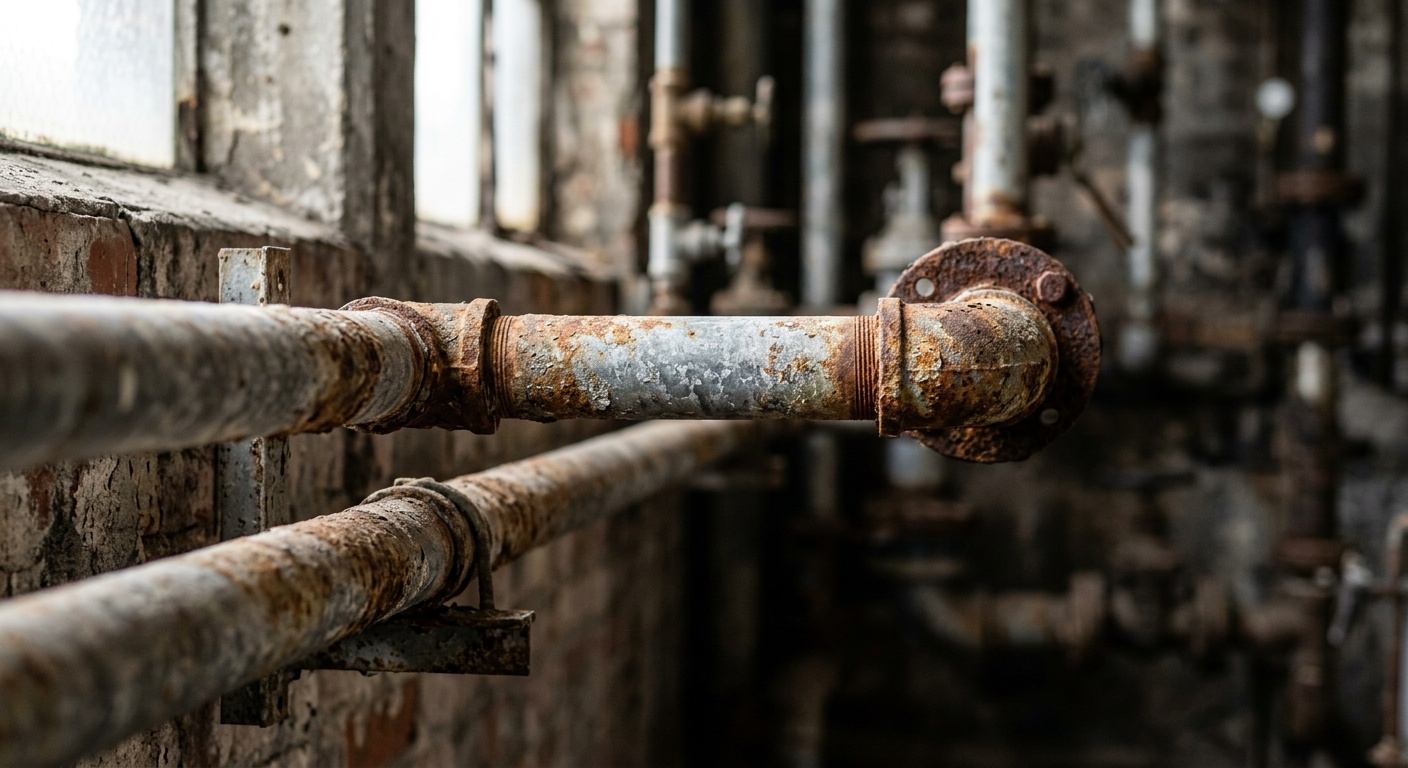
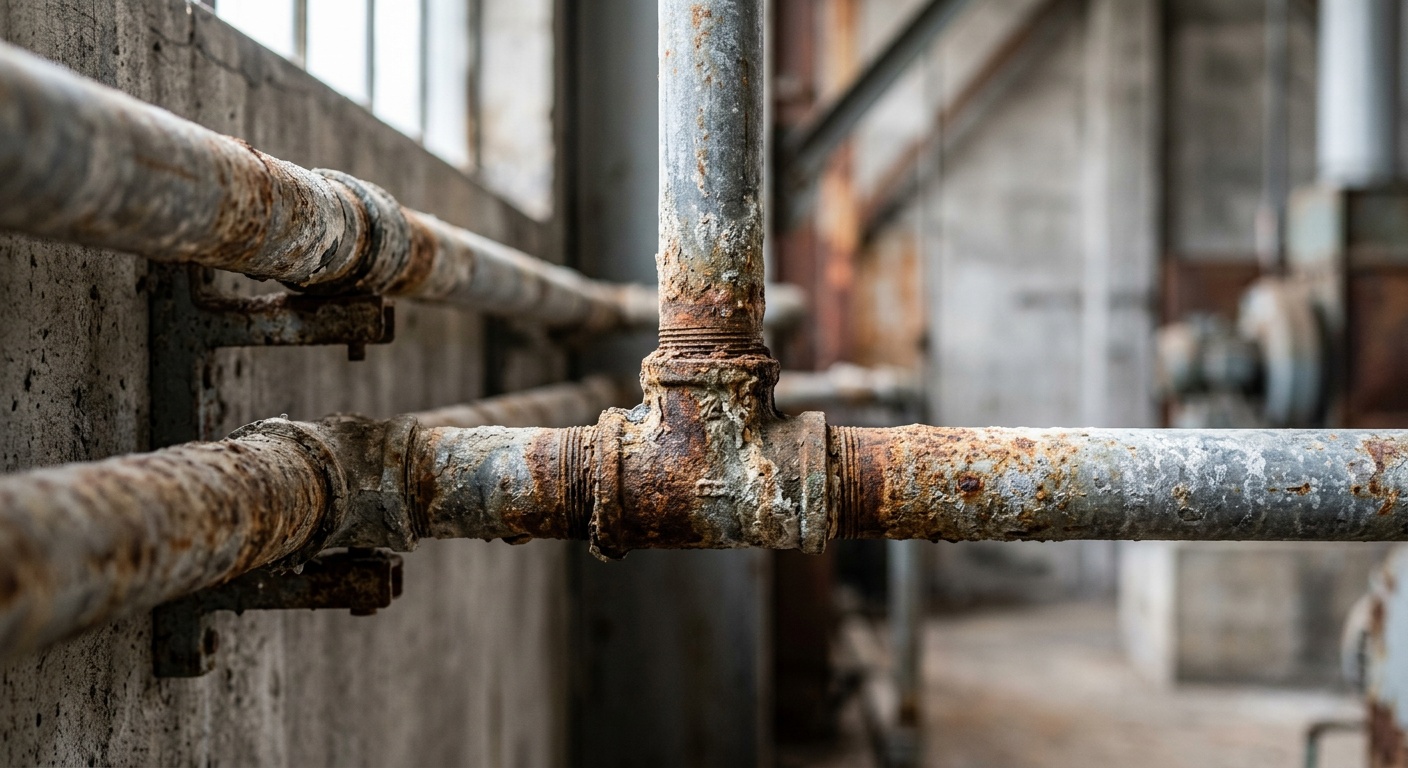
Galvanized steel was the dominant pipe material for residential water supply lines from the late 1800s through the 1960s. These pipes are coated with a layer of zinc intended to prevent corrosion — but here’s the critical failure point: over decades, the zinc coating erodes from the inside out. What remains is bare steel that corrodes progressively, building up rust deposits that narrow the pipe’s interior diameter and eventually flake off into your drinking water.
A galvanized pipe installed in 1955 is now 71 years old. Its expected useful life was 40 to 70 years under ideal conditions. In Southern California’s hard water environment, that timeline shortens considerably. If your home has galvanized supply lines and they haven’t been replaced, you’re almost certainly living on borrowed time.
Visual signs of galvanized pipe failure include:
- Brownish or rust-colored water, especially after the water hasn’t been run for several hours
- Reduced water pressure throughout the home
- White or rust-colored stains in sinks, tubs, and toilets
- Visible corrosion at pipe connections and joints near shutoff valves
Cast Iron Drain Lines
Cast iron was the standard material for drain, waste, and vent (DWV) systems in homes built through the 1970s. Unlike galvanized supply lines, cast iron drains are often considered more durable — but “more durable” doesn’t mean “indefinitely reliable.” After 50 or more years, cast iron pipes develop internal corrosion, cracks, and root intrusion vulnerabilities that can cause slow drains, sewage backups, and foundation damage.
In Southern California, where large ficus and eucalyptus trees are common in older neighborhoods, root intrusion into cast iron drain lines is a pervasive problem. Roots exploit tiny cracks or joint failures with remarkable efficiency. A slow drain that doesn’t respond to plunging is often not a clog — it’s a root mass 10 feet down the line.
Lead and Copper Service Lines
While copper gained popularity as a supply line material from the 1950s onward and is generally reliable, older homes may still have lead solder connecting copper pipes (used widely before 1986) or even lead service lines connecting the home to the municipal water main. The EPA estimates that up to 10 million homes nationwide still have lead service lines, and Southern California is no exception.
Lead exposure through drinking water is a serious public health concern with no safe threshold, particularly for children and pregnant women. California’s AB 2060, signed into law in 2022, created frameworks for lead service line inventories and replacement programs, but thousands of properties in Los Angeles, San Bernardino, and Riverside counties had not yet completed inventories as of early 2026.
Orangeburg Pipe
This is the pipe material most homeowners have never heard of — and the one that can cause the most dramatic failures. Orangeburg was a cheap, bituminous fiber pipe used primarily for sewer lines in homes built between the 1940s and early 1970s. Made from layers of wood pulp and pitch pressed together, it was intended as a temporary wartime substitute for metal pipes. In practice, it was installed in hundreds of thousands of Southern California homes and left in place permanently.
The problem: Orangeburg absorbs moisture over time, loses its circular shape, and collapses. A collapsed sewer line means raw sewage backing up into your home. Repair or replacement is typically a $5,000 to $15,000 project. If your home was built between 1945 and 1972 and the sewer line has never been inspected, there is a real possibility of Orangeburg lurking underground.
The Critical Red Flags You Must Never Ignore
Red Flag #1: Persistent Low Water Pressure
Water pressure that’s noticeably weak throughout your entire home — not just one fixture — is a systemic red flag. In pre-1980 homes, this almost universally points to galvanized pipe corrosion narrowing the interior diameter of supply lines. Unlike a failing pressure regulator (a common issue that affects the whole system but has a straightforward fix), galvanized corrosion is progressive and affects multiple sections of pipe simultaneously.
The test: Check the pressure at multiple fixtures. If the kitchen and bathrooms all have weak flow, and your municipal water pressure is confirmed normal (you can check with a simple gauge from a hardware store), the pipes themselves are restricting flow.
Red Flag #2: Discolored Water
Yellow, orange, or brown water — even if it only appears when you first turn on the tap after a long absence — is a direct symptom of internal pipe corrosion. Don’t rationalize this away. Some homeowners are told to “just run the water until it clears,” which treats the symptom while the source continues to deteriorate. Rust in your water is also a health concern and can damage water-using appliances including dishwashers, washing machines, and water heaters.
Red Flag #3: Unexplained Wet Spots, Mold, or Warm Floor Areas
In Southern California, the majority of pre-1980 homes were built on concrete slab foundations — which means the water supply lines were run through or beneath the slab. When these pipes fail (a phenomenon called a slab leak), the water seeps upward through the concrete. Signs include:
- Warm spots on tile or hardwood floors, indicating a hot water line leak
- The sound of running water when all fixtures are off
- Mold or mildew appearing on baseboards or lower walls
- Unexplained spikes in your water bill
- Cracks appearing in slab-level flooring
The Los Angeles Department of Water and Power has noted in its public advisories that slab leaks account for a significant portion of residential water loss in older communities, and the problem is particularly pronounced in the San Fernando Valley and older parts of the Eastside where copper-over-slab construction was standard.
Red Flag #4: Multiple Slow Drains
A single slow drain is usually a local clog. Multiple slow drains throughout the home — especially when toilets gurgle when you run a sink, or tubs drain slowly — indicate a problem with the main drain line or sewer lateral. Combined with the presence of mature trees near the sewer route, this pattern almost always warrants a professional sewer scope inspection.
Red Flag #5: Visible Pipe Corrosion and DIY Patchwork
Look under sinks, around the water heater, and near your main shutoff valve. Green or blue-green staining on copper pipes indicates corrosion at joints. White calcium buildup is a mineral deposit issue. But the most concerning sight in many older homes is the patchwork history — sections of mismatched pipe materials joined together by previous owners or handymen over decades. These transitions between dissimilar metals can accelerate galvanic corrosion and represent some of the most likely failure points in the entire system.
Red Flag #6: Original Water Heater
A water heater more than 15 years old is approaching or beyond its typical service life. In pre-1980 homes with no record of updates, it’s not uncommon to find water heaters installed in the late 1990s or early 2000s that are still in service in 2026 — well past their warranty and design life. An aging water heater can leak suddenly and catastrophically, particularly if the anode rod (the sacrificial metal rod that prevents tank corrosion) has never been replaced.
Real Stories from Southern California Homeowners
The Glassell Park Surprise
In early 2025, a family purchased a 1962 bungalow in Los Angeles’s Glassell Park neighborhood. The home inspection noted “older plumbing” but didn’t specify materials or recommend a sewer scope. Six months after closing, sewage began backing up into the first-floor bathtub. A plumber’s camera inspection revealed a section of Orangeburg sewer pipe that had fully collapsed approximately 8 feet from the house. The repair — requiring excavation through the front yard and replacement of the lateral to the street — cost $11,400. A pre-purchase sewer scope inspection would have cost approximately $300 and could have been used to negotiate a seller credit.
The Torrance Water Bill Mystery
A retired couple in Torrance noticed their water bill gradually climbing over 18 months, from roughly $85/month to over $200/month. They assumed it was rate increases. A plumber was called after they heard water running at 2 a.m. with everything off. Electronic leak detection found two active slab leaks in the 1958 home’s copper supply lines beneath the kitchen and hallway. Total repair cost: $7,200. The leaks had likely been active for over a year, and the cumulative water loss — not counting the structural moisture damage — was thousands of gallons.
Southern California-Specific Factors That Accelerate Plumbing Failure
Hard Water and Mineral Buildup
Southern California receives its water from three main sources: the Colorado River Aqueduct, the State Water Project (Northern California), and local groundwater. All three sources deliver water with relatively high mineral content — particularly calcium and magnesium — making Southern California water notably “hard.” The Metropolitan Water District’s 2025 water quality report showed average hardness levels of 280–380 mg/L (classified as very hard) across much of the service area.
Hard water accelerates scale buildup inside pipes, reducing flow and stressing pipe walls. It also shortens the life of water heaters, washing machines, and dishwashers. For galvanized pipes already compromised by corrosion, hard water dramatically accelerates the timeline to failure.
Seismic Activity and Ground Movement
Southern California sits atop one of the world’s most complex fault systems. While major earthquakes get the headlines, the region experiences constant low-level seismic activity and soil movement. This ground movement stresses underground pipe connections, particularly at joints — which is precisely where aging pipe materials are most vulnerable. Post-earthquake plumbing inspections consistently reveal cracked pipe joints and displaced drain lines in older neighborhoods, even after events too small to notice.
Drought Cycles and Soil Shrinkage
California’s persistent drought cycles cause expansive clay soils — common across Los Angeles Basin, the Inland Empire, and parts of San Diego County — to shrink and crack during dry periods and then expand when rain returns. This movement directly stresses underground pipes, particularly sewer laterals. The dramatic atmospheric river events of 2023 and 2025, following extended drought periods, resulted in a spike in reported slab leak and lateral failure calls across the region.
Plumbing Materials Comparison Table
| Pipe Material | Era Used | Expected Lifespan | Key Risk | Urgency Level |
|---|---|---|---|---|
| Galvanized Steel | 1880s–1960s | 40–70 years | Corrosion, low pressure, rust in water | CRITICAL |
| Orangeburg (Fiber) | 1940s–early 1970s | 50 years max | Collapse, sewage backup | CRITICAL |
| Cast Iron (DWV) | Pre-1980 | 75–100 years | Internal corrosion, root intrusion, cracks | MODERATE–HIGH |
| Copper (Slab-Run) | 1950s–1970s | 50–70 years | Slab leaks from pinhole corrosion | MODERATE–HIGH |
| Lead Service Lines | Pre-1950s | N/A (health hazard) | Lead contamination in drinking water | IMMEDIATE ACTION |
Risk Visualization: Common Plumbing Issues by Decade Built
The following chart represents the estimated prevalence of major plumbing problems in Southern California homes based on decade of construction, drawing from contractor survey data and insurance claim records compiled through 2025.
1940s Homes — Galvanized/Orangeburg Risk
1950s Homes — Slab Leak / Galvanized Risk
1960s Homes — Mixed Pipe / Slab Leak Risk
1970s Homes — Copper Corrosion / Cast Iron Risk
Post-1980 Homes (Baseline Reference)
Source: Composite data from Southern California licensed plumbing contractors and insurance industry reports, 2024–2025.
What To Do If You Spot These Red Flags
Step 1: Get a Professional Plumbing Inspection — Not Just a Home Inspection
Standard home inspections are visual assessments. A licensed plumber with video camera equipment can actually look inside your pipes. For any pre-1980 home purchase or if you’ve been living in an older home without a plumbing assessment, commission a dedicated plumbing inspection that includes a sewer scope (camera through the drain line to the street) and an assessment of visible supply line materials. This typically costs $250–$600 and is the single highest-value diagnostic investment you can make in an older home.
Step 2: Know Your Priorities — Not Everything Needs Immediate Replacement
A comprehensive plumbing assessment can feel overwhelming, but not all issues are equally urgent. Use this priority framework:
- Immediate (within 30 days): Lead service lines, active leaks, collapsed drain lines, water heaters showing signs of failure
- High priority (within 6 months): Galvanized supply lines showing corrosion, suspected Orangeburg sewer laterals, slab leak indicators
- Monitor and plan (1–3 years): Cast iron drains without current failure symptoms, copper pipes in good condition but aging
Step 3: Understand Your Repiping Options
If your galvanized supply lines need replacement, the most common modern alternatives are PEX (cross-linked polyethylene) and copper. PEX has become the dominant choice for whole-home repiping projects in Southern California for several reasons: it’s flexible (reducing the number of joints and therefore failure points), resistant to scale buildup, more affordable than copper, and easier to route through existing walls with minimal demolition. A whole-home repipe with PEX in a typical 3-bedroom Southern California home typically costs $4,000–$9,000 as of 2026, depending on home size and access complexity.
Step 4: Check for Water Damage and Mold
If you’ve identified a long-standing leak or slab leak, the remediation process extends beyond the plumbing repair itself. Moisture trapped under flooring or inside walls can develop mold within 24–48 hours in Southern California’s warmer climate. After any significant plumbing repair in an older home, have a moisture assessment performed before closing up walls or installing new flooring.
Step 5: Inform Your Insurance Provider
Once you’ve completed plumbing upgrades — particularly a full repipe — notify your homeowner’s insurance carrier. Many insurers offer premium reductions for documented plumbing improvements in older homes, and some carriers who previously excluded water damage coverage due to pipe age will restore standard coverage after a verified repipe. Document all work with permits (required for repiping projects in all Southern California jurisdictions) and keep contractor invoices and inspection reports permanently in your home file.
Frequently Asked Questions
How do I find out what type of pipes my pre-1980 Southern California home has?
The most reliable starting point is to look at exposed pipe sections under sinks, near the water heater, and in any accessible crawl space or utility area. Galvanized steel pipes are grayish-silver in color and feel rough to the touch, often showing surface rust. Copper pipes are orange-brown and develop a greenish patina over time. If you can’t determine the material visually, a licensed plumber can identify pipe materials during an inspection and, in the case of underground or in-slab pipes, use electronic detection equipment. Your local building department may also have permit records from previous plumbing work that identify materials used.
Is a sewer scope inspection really necessary before buying an older Southern California home?
Absolutely — and not just recommended but arguably essential for any home built before 1975. Standard home inspections do not include sewer scope inspections, meaning a buyer can complete a purchase with a clean inspection report while unknowingly inheriting a collapsing Orangeburg sewer lateral. In Southern California’s competitive real estate market, buyers sometimes waive inspections entirely, which is financially dangerous with older homes. A sewer scope typically costs $250–$400, takes under two hours, and can reveal problems that would cost $5,000–$20,000 to repair. Real estate professionals increasingly recommend it as standard practice for all pre-1980 purchases.
Can I get a permit and do plumbing work myself to save money in California?
California law does allow licensed homeowners to pull permits for plumbing work on their primary residence — but the key word is “licensed,” which in this context means completing the permit application as the owner-builder. However, the practical reality is that significant plumbing work in older Southern California homes — whole-home repiping, slab leak repairs, sewer lateral replacement — requires skill, specialized equipment, and knowledge of local code requirements that make DIY approaches genuinely risky. Improperly executed plumbing work can void homeowner’s insurance, create liability issues when selling, and in cases involving lead or sewage, create serious health hazards. For minor repairs and fixture replacements, an experienced DIYer can manage well. For anything involving the main supply system or drain laterals in a pre-1980 home, professional licensed work is strongly advisable.
Your Pre-1980 Plumbing Action Roadmap
You now have a clear picture of what lurks in the walls and beneath the slabs of Southern California’s vintage housing stock. The aging plumbing crisis in this region is real, growing, and directly connected to broader trends: tightening insurance markets, increasing water scarcity, and a housing inventory dominated by homes that are approaching their second plumbing lifespan. The homeowners who navigate this terrain successfully are those who approach it proactively rather than reactively.
Here’s your practical roadmap for immediate implementation:
- Within the next 2 weeks: Do a visual inspection of all accessible pipes in your home — under every sink, around the water heater, and in the garage. Note material types, corrosion, and any patching. Photograph everything.
- Within 30 days: Commission a professional plumbing inspection with sewer scope if you’ve never had one. This is the single most important diagnostic step you can take.
- Within 60 days: Based on inspection results, get at least two quotes for any priority repairs. Ask specifically about PEX repiping options and check with your local municipality about any rebate programs for plumbing upgrades (several Southern California water districts offer them).
- Within 6 months: Address all critical and high-priority items with properly permitted work. File all permits and contractor documentation.
- Annually going forward: Check water pressure, look for early corrosion signs, flush your water heater, and inspect the main shutoff valve to ensure it operates correctly.
Key takeaways to carry forward:
- Pipe material is destiny — knowing what’s in your walls is the foundation of everything else
- Southern California’s hard water, seismic activity, and drought cycles accelerate aging pipe failure faster than national averages suggest
- A sewer scope inspection is not optional for pre-1975 homes — it’s the single highest-ROI plumbing diagnostic available
- Insurance market changes in California are making proactive plumbing upgrades a financial imperative, not just a comfort decision
- PEX repiping offers the best combination of durability, cost-effectiveness, and installation simplicity for most Southern California older homes
Here’s the question worth sitting with: If a pipe in your home failed tonight, do you know where your main shutoff valve is and how to operate it? If the answer is no — or even “I think so” — that’s your very first action item. In the world of pre-1980 plumbing, the difference between a manageable repair and a $50,000 catastrophe is often measured in minutes.
Your vintage Southern California home has history, character, and charm that no new build can replicate. With the right plumbing knowledge and a proactive approach, it can also have a future — leak-free, code-compliant, and properly insured — for decades to come.